Resources are the raw materials behind all crafting and location upgrades. You gather them at guild castles, Holy Temples, farms, [mines](/wiki/crafting-guides/mining) and lumbermills with a pickaxe, scythe, woodcutting axe or shovel — all made in [Engineering](/wiki/crafting-guides/engineering-tools) — and out in the wilderness too. Every natural node has a semi-random respawn timer, so a mined node might return anywhere from 25–45 minutes later rather than exactly on the half hour.
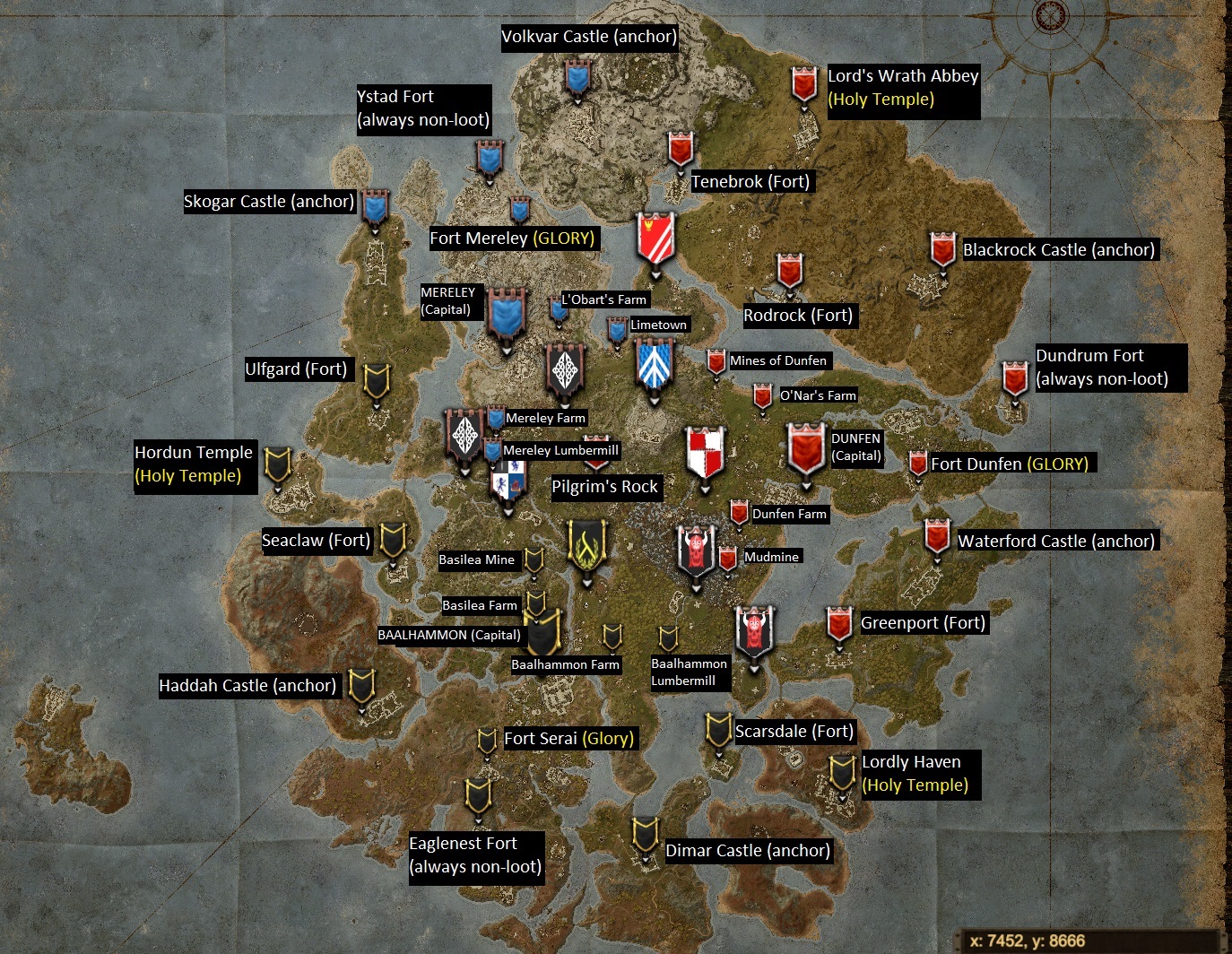
Claim a resource location to gain access to its resources. To see what a spot offers, click its flag on The Map to read its Resource Card — which shows what's there when fully upgraded and at max efficiency. You may need to upgrade buildings or fill the bastion first.
Resources aren't tied only to flags — they're scattered all over the map, and the rarest are found guarded by powerful enemies out in the wilds, so it pays to explore.
Farms & crops
Farms have flat land for crops plus beehives for honey and beeswax. Soil quality comes in three grades — 50%, 80%, 100% — with the poor soil in safe zones near the capital and the best soil in dangerous areas. For the full guide and the specialty locations, see Farming.
Mines & ores
Mines yield stones for building, ores for smelting, and minerals for many crafts. Common ores sit near the capital; rarer ones are at Holy Temples and Guild Provinces. Upgrading a mine adds more nodes and more variety. What each rock and mineral is for:
| Mineral | Primary use |
|---|---|
| Coal | Fuel |
| Limonite | Iron lump |
| Pyrite | Steel |
| Tektite | Aqua Fortis |
| Sulfur | Aqua Fortis |
| Nitre | Aqua Fortis |
| Calcite | Dziwer |
| Siderite | Dziwer |
| Quartz | Bulat |
| Magnetite | Bulat |
| Salt | Cooking |
| Limestone | Building material & lime mortar |
| Clay | Building material & bloomery construction |
| Gneiss | Building material & furnace construction |
| Granite | Building material & furnace construction |
Veins
- Veins are large deposits found at mines (and rarely in the wild), always of the mine's specialty type.
- Huge total yield, but a long gathering time and long respawn — best mined in groups of 5+ for the yield bonus.
- A Rare Resource Vein yields a mix of quartz, tektite, siderite, calcite, nitre and sulfur. See Mineral Specialties for where to find them.
Gold Pickaxes
Gold Pickaxe icons appear on the map from time to time — sites loaded with a randomised mineral, stone or ore, usually including at least one vein. Expect open-world PvP when you go for one.
Lumbermills & wood
Lumbermills gather and process wood. There are five types — Pine, Yew, Ash, Oak and Elm. Wood type rarely matters for weapon or armour crafting, but it does matter for upgrading structures, where each upgrade level only accepts certain woods.
- Pine — typically used for billets.
- Oak, Ash, Elm — higher-level building upgrades.
- Yew — preferred for bows (but not required).
A lumbermill's level sets how many wood nodes spawn and what type. Holy Temples and Guild Provinces carry the most and best wood — see Lumber Specialties, and always check the bastion and upgrade level before harvesting. For tools and tiers, see Wood Cutting.
Butchering & fishing
- Butchering — animal carcasses are butchered at the Tailoring & Leatherworking workshop for bones, leather, meat and suet (not every animal drops all four), and decay after 7 days. Needs the Expanded Animals Butchering book (10 silver, capital leatherworking vendor); Beast Butchering from the Glory Quartermaster handles old animals that drop beast leather. See Animals.
- Fishing — done actively or passively with a rod, or hands-off with a Fish Trap. Fish feed the kitchen and oil-making. See Fishing.