Crafting in Gloria Victis is a nested system: low-tier materials feed higher-tier items, and many items need materials from several professions at once. That keeps every material in demand and ties the crafting professions together.
If you want to be fully self-sufficient, expect to level multiple crafting professions.
Crafting professions
The crafting professions are:
- Forestry and Farming
- Cooking and Herbalism
- Tailoring and Leatherworking
- Engineering
- Mining and Metallurgy
- Armorsmithing
- Weaponforging
- Artificing (unused)
Crafting levels go up simply by crafting items — there are no crafting skill trees.
Using the crafting menu
Press C to open the crafting menu. Pick the profession you want to look at (top-left), where you'll also see your current level and XP in it. Select a recipe to view its required materials, the workshops suitable for it, and your crafting chance.
Materials must be in your character inventory — not in storage — to count toward a craft.
Each recipe shows a crafting-level bracket, e.g. 12 – 25. The left number is the minimum level to make the item; the right is the maximum level at which you still earn full XP. Craft past that maximum and your XP for that item is significantly reduced.
Recipe colour coding — the menu colours each recipe by two things at once — whether you're at the right workshop, and whether you have the materials:
- Right workshop + have materials — ready to craft.
- Wrong workshop + have materials — move to the proper workshop first.
- Right workshop + missing materials — gather or buy what's short.
- Wrong workshop + missing materials — both still to sort out.
Crafting at the proper workshop produces more items and a higher chance of higher-quality gear — the window shows a range such as "you will gain 7–14 items." Click the triangle next to a material to see what you can substitute when you have choices.
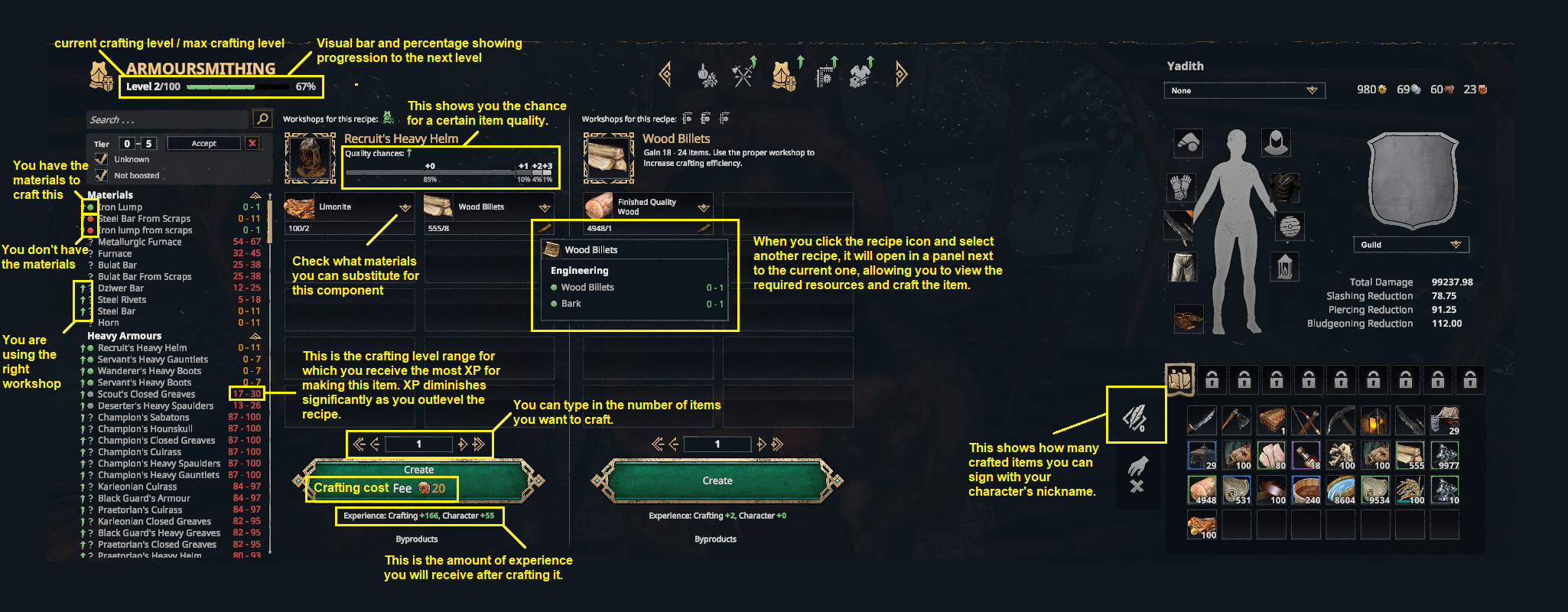
Crafting costs money
Every craft charges a fee. Crafting at your guild castle sends that fee straight into your guild bank; crafting anywhere else just sinks the money.
Getting started
Step 1 — Buy starter recipes — in your starter city, buy recipes from:
- General Merchant
- Food & Herb Merchant
- Armorsmith
- Weaponsmith
- Tailor
- Leatherworker
If a recipe costs more than 10 silver, skip it for now and come back later. Also buy 20 of each seed from the Food Merchant.
Step 2 — Get gathering tools — you'll need:
- Pickaxe
- Woodcutting Axe
- Scythe
- Buckets of Water
These come from the General Merchant or the Market.
Step 3 — Gather materials — look on the map for:
- Farms (crops)
- Lumbermills (wood)
- Mines (ore)
PvP warning
These gathering areas are PvP zones — you can be attacked and looted. As a beginner, gather near cities close to your capital — Ystad Village, Eaglenest, Dundrum — and gather everything, including animal carcasses.
Workshops
Most crafting requires a workshop, and workshops have a quality level. Higher quality means better material yield and higher gear quality.
| Workshop quality | Where |
|---|---|
| +0 to +3 | Nation territory — castles, forts, mines, lumbermills, farms |
| +4 (best) | Guild provinces & mid-zone castles |
Don't craft in the capital city — its workshops are low quality or missing. For more on stations and tiers, see Crafting Workshops.
Personal crafting stations (AFK)
You can place your own stations for semi-AFK crafting that also gives XP while they run:
- They can be raided by enemies if left in a loot zone.
- The decay timer varies by station: Furnaces and Campfires despawn after 72 hours (3 days), while Bloomeries and Metallurgic Furnaces last 5 days.
- Materials inside are returned to The Market — the "My Offers" tab — after despawn.
Getting recipes
Recipes come from City Vendors, loot from humanoid mobs, the Contribution Points vendor at a Nation Fort, chests around the map, disassembling items (a Critical Success learns the recipe), and the Market — though be careful, as some players resell vendor recipes.
You do not need any crafting level to learn a recipe — learn everything immediately. For the full breakdown, see Acquiring Recipes.
Making money crafting
The best starter earners:
- Cooking & Herbalism — especially Bread.
- Selling raw materials.
- Selling processed materials — Flax Canvas, Steel Bars, Rivets, Hide Glue.
Early on, selling materials is easier than selling gear. High-quality gear (+5 / +6) sells for much more later.
Best places for high-tier materials
Holy Temples
- Hordun
- Lord's Wrath Abbey
- Lordly Haven
Guild Castles are also strong. Other methods:
- Farm giants, spiders, darkhounds.
- Mine magnetite nodes.
- Run the Volcano dungeon.
- Fight Sea Wraiths.
- Raid enemy storehouses.
- Loot enemy players.
- Buy from the Market.
Special materials
Some materials only come from specific sources:
| Material | Source | Profession |
|---|---|---|
| Suet | Old animals, lynxes | Leatherworking |
| Mistletoe | White bark trees | Cooking / Herbalism |
| Elite Quilted Canvas | Dungeon / Glory Vendor | Tailor / Armorsmith |
| Aqua Regia | Dig pit | Metallurgy / Armorsmith / Weaponsmith |
Efficient gathering tips
- Use a fully upgraded mine / lumbermill / farm.
- Use Craftsman or Master tools for faster gathering.
- Run gathering circuits — farm → lumber → mine → repeat.
- Bank materials often.
- Split stacks in your inventory.
You cannot AFK gather — an anti-bot NPC will kill you. Only dig-pit gathering is safe AFK.
Crafting buffs
| Buff | Effect |
|---|---|
| XP Cards | +20% to +240% Crafting XP |
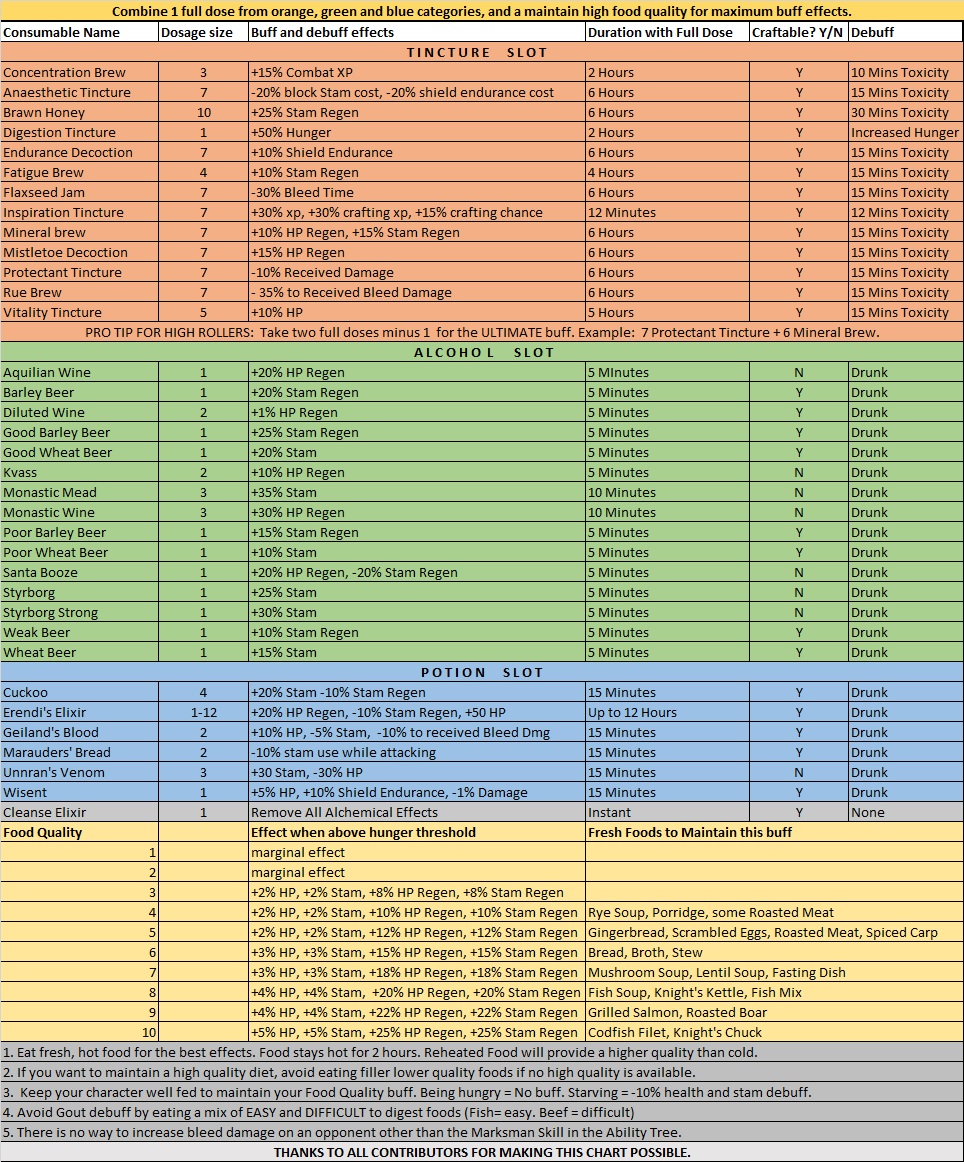
| Inspiration Tincture (drink 7) | +30% Craft XP & Craft Chance |
| Territory Control Buff | Craft bonus |
| Deadly Harvest Buff | Craft bonus |
The more territory your nation owns, the better these buffs — so the bigger your Territory Control buff, the more crafting "luck" you have.
Final advice
You don't have to be a crafter, but guilds expect members to contribute — by providing materials, crafting gear, and sharing crafting knowledge. At minimum, every player should learn the basic recipes to help guild production.