Smelting turns raw ore and other materials into the bars and refined stock every metal trade depends on. Unlike most crafting, it isn't done at a fixed workshop — you place your own workstations in the world, load them with fuel and materials, switch them on, and leave them running semi-AFK while you go fight, farm or craft elsewhere.
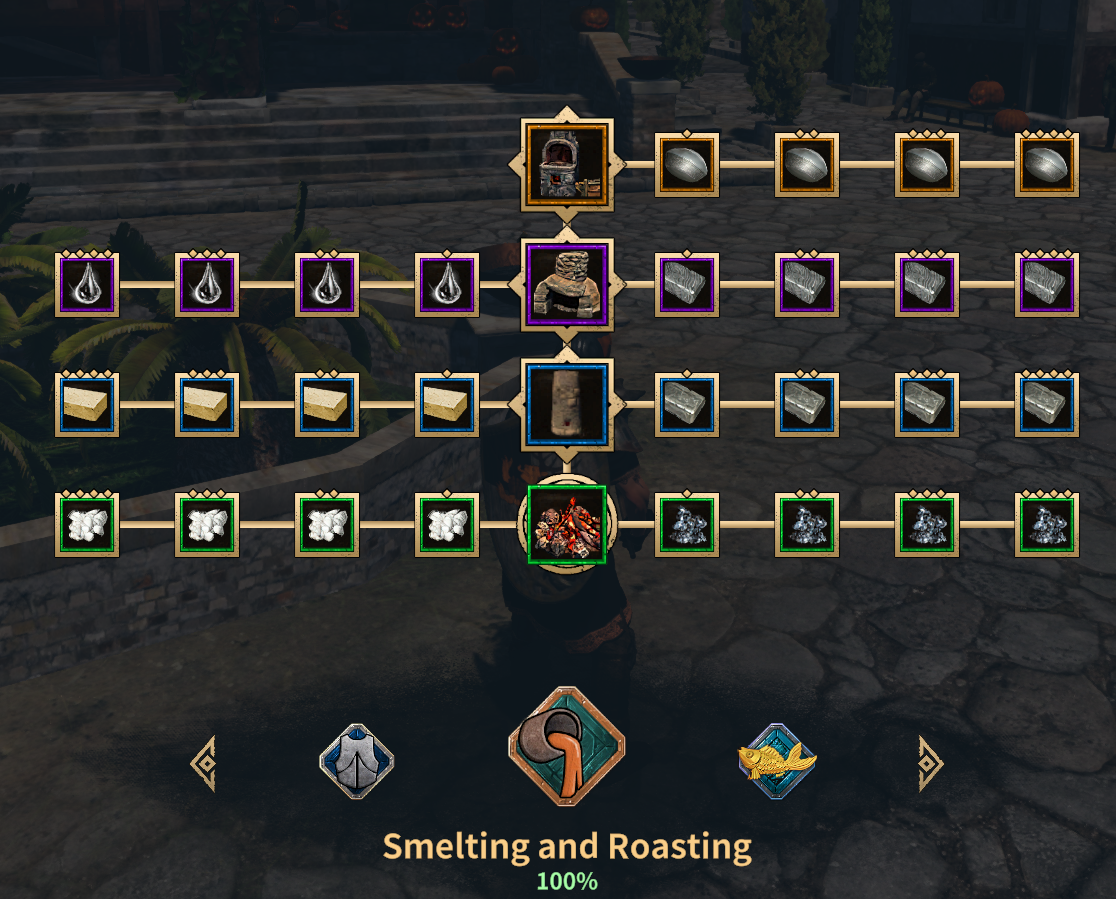
Smelting workstations
Smelting is done at player-made Constructions called workstations. They're crafted directly in your inventory — not at any workshop — and placed in the world by right-clicking them and selecting "Use". There are four, each suited to a different heat range:
| Workstation | Max temp | Suited to |
|---|---|---|
| Campfire | Lowest | Simple meals, plus Quicklime and Iron Lumps |
| Bloomery | 4 — low | Chamotte, Iron Lumps and Steel |
| Furnace | 5 — medium | Quartz Glass, Steel and Dziwer |
| Metallurgic Furnace | 6 — high | Dziwer and Bulat |
- All four workstations may be built and running simultaneously once unlocked, for multiplied production.
- Placing a station in certain areas grants a production-speed bonus — see Crafting Districts for the full speed table. In-game, a smelting station's bonus shows as a "Smelting District bonus."
The workstation screen only shows the speed bonus from your placement location. Bonuses from leveling the Smelting and Roasting tree still apply automatically, even though they aren't displayed there.
Fuel & temperature
Every campfire or furnace needs fuel to heat up. There are three primary fuels, each burning to a different maximum temperature:
| Fuel | Max temperature |
|---|---|
| Wood Billets | 4 |
| Charcoal | 5 |
| Coal | 6 |
Each recipe lists a temperature range — for example Iron Lump smelts at temp 2–6 — and any item that needs heat must reach at least its minimum. Some items, like Iron Lumps, can be made by simply heating billets; hotter items like the Bulat Bar require the higher ceiling of coal. A station only gets as hot as both its own cap and the fuel you feed it allow.
Mind the heat
As the flames consume the fuel, the workstation's temperature drops over time — come back every now and then to check the heat and click the bellows to pump it back up.
Smelting yield
Each smelting action produces between 1 and 2 bars. Three things affect whether you get the extra bar:
- Looting chance bonus — your Nation Bonus plus any other Loot Chance bonuses you have active, such as Cards.
- Mentor Points — the more, the better.
- Temperature — the ideal temp for the item you're crafting gives the best chance at bonuses. A temperature that's too high or too low reduces this chance a lot.
For the wider success-and-quality system these feed into, see Crafting Chance.
Looting & destroying workstations
Workstations are not a safe depot
If placed in a loot-enabled area, a Campfire, Bloomery, Furnace or Metallurgic Furnace can be 100% emptied and its contents stolen by enemy nation players — there is no limit on looting these stations. Members of your own nation can never loot your nation's workstations.
At guild castles, furnaces may be destroyed by the guild leader — this usually happens during castle construction, when someone needs to build where the furnaces are sitting. Any workstation destroyed this way is 100% deleted: every material inside is permanently gone. Be very careful before deleting another player's workstation, and warn people in advance so they can empty theirs.
Best practices — hard-won guild habits that keep materials out of enemy hands:
- Always empty your workstations before State of War at your guild province.
- Don't keep too much in a workstation at once — it is NOT a secondary depot. Heat up a batch, craft it, then return the products to your depot so a breach can't cost you large sums.
- Never log off with materials still in a workstation if there's even a small chance an enemy could loot it.
- Don't leave workstations unattended at frequently sieged outer-ring castles like Haddad, Volkvar or Blackrock.
- Guild leaders should set door permissions to "move through" so doors aren't left open at Guild Provinces.